
How it works
How Our Online Quran Classes Work
Live one-to-one video lessons with a qualified teacher. Here is exactly what happens in a class, what you need to join, and how to start with a free trial.
The short answer
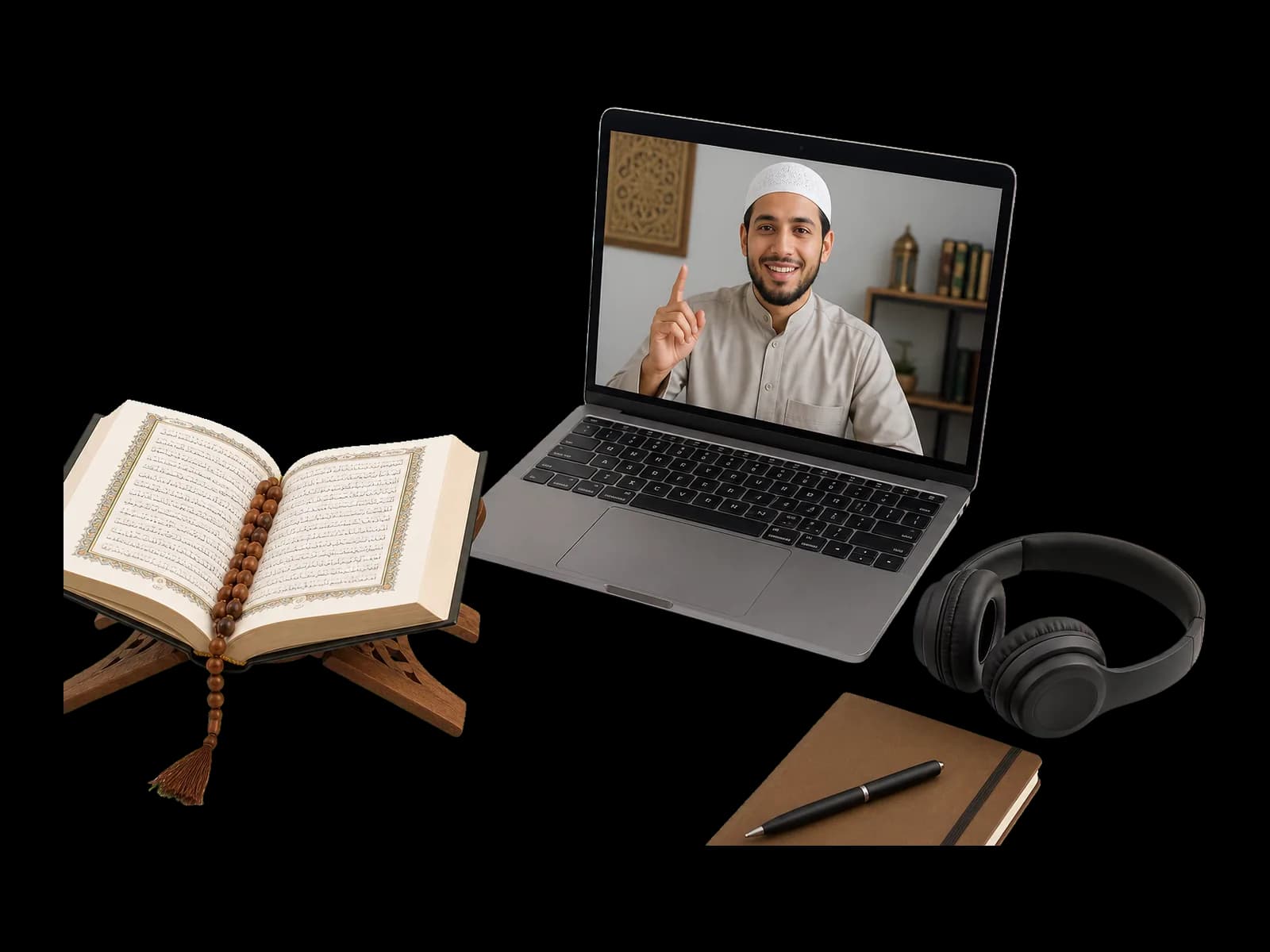
If you are wondering how online Quran classes work, the answer is simpler than most people expect. At your agreed time you open a link your teacher shares and a private video call begins — one teacher, one student, never a group and never a recording. Your teacher puts the Quran or lesson book on screen, listens to you recite, and corrects your pronunciation the moment something slips.
There is no special software to buy. A phone, tablet or laptop and a stable internet connection are enough. You pick the days and times that fit around school, work and family, and you can request a male or female teacher when you sign up — meet our Quran teachers before you book anything. The first class is a free trial with no card required, and monthly plans can be cancelled at any time.
Getting started
Four steps to your first class
From signing up to reciting with your teacher, most students are in their first lesson within a couple of days.
- 1
Book your free trial
Create an account and request a trial class. No card details are needed at this stage.
- 2
Tell us your level and times
Say whether you are a complete beginner or already read, and which days and times suit your week.
- 3
Meet your teacher
We match you with a qualified teacher and send a link for a private video call at the agreed time.
- 4
Start your lessons
If the trial feels right, choose how many classes a week you want and settle into a regular routine.
What actually happens in a 30-minute lesson
Every class follows the same familiar rhythm, so a student always knows what is coming next.
Minutes 1–5, greeting and revision. Your teacher says salaam, asks how the week went, then listens to you read back the passage you covered last time. This shows immediately what has stuck and what needs another look.
Minutes 5–15, the new lesson. The teacher shares the page on screen and reads the new lines first, slowly, so you hear the correct sound before attempting it yourself. Beginners work through the Noorani Qaida letter by letter; confident readers move on through Nazra reading or a new Tajweed rule; Hifz students take their new sabaq.
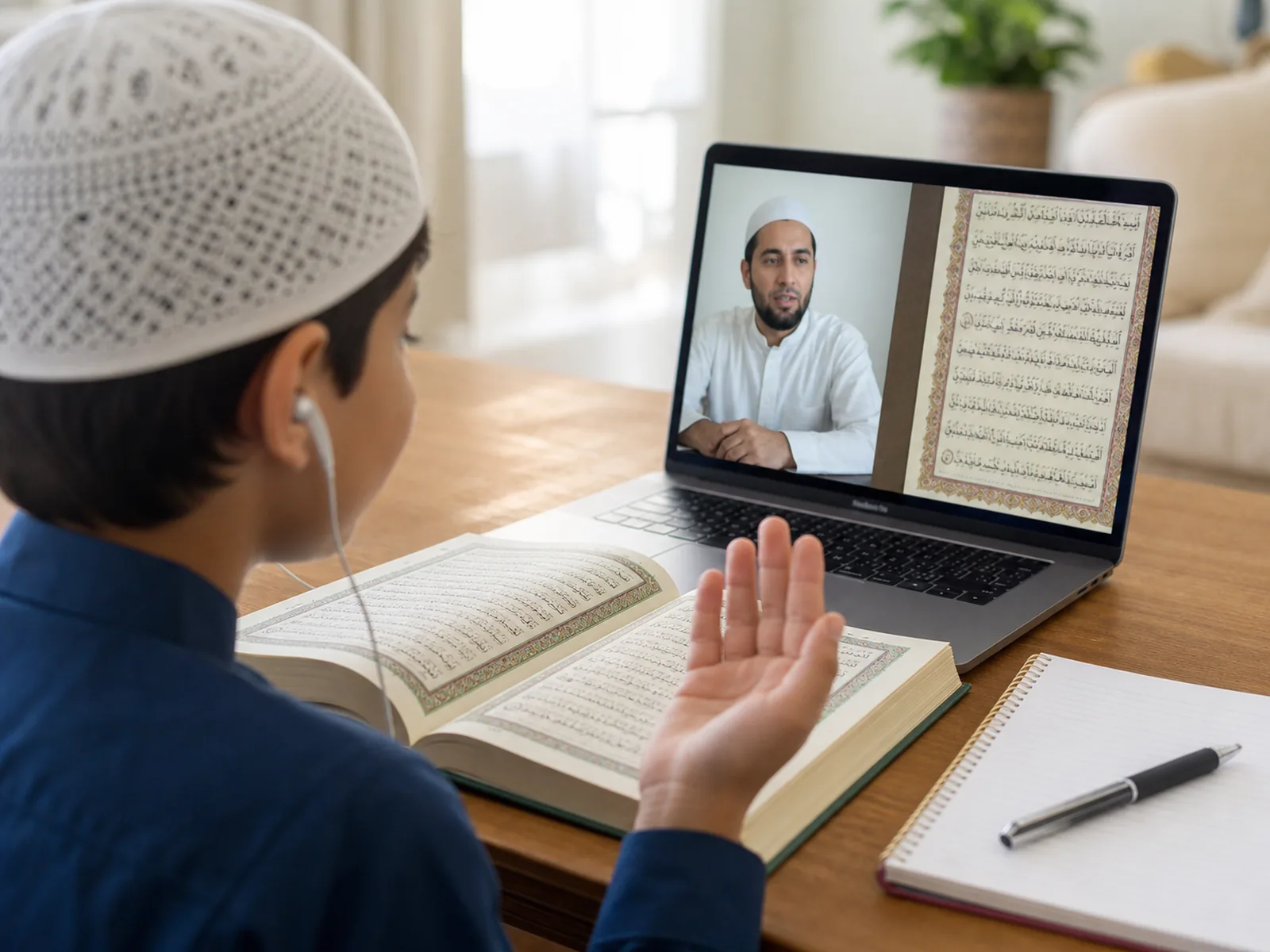
Minutes 15–25, you recite. This is the heart of the class. You read aloud and your teacher stops you the moment a letter comes from the wrong place, models the correct makhraj, and has you repeat it until it is right. In a room of fifteen children most students never get this. One to one, it happens dozens of times in half an hour.
Minutes 25–30, what to practise. Your teacher sets exactly what to revise before next time — a few lines, one rule, or a portion to keep warm — and notes it for your monthly report.
What you need
Everything required to join a class
A device with a microphone
A phone, tablet or laptop is fine. A webcam is welcome but not essential — your teacher mainly needs to hear you clearly.
A stable internet connection
Ordinary home broadband or a decent mobile signal is plenty. A video lesson uses far less data than streaming a film.
Headphones and a quiet spot
Neither is compulsory, but headphones sharpen every letter and a quiet corner keeps a young learner focused for the full half hour.
A Quran or Qaida (optional)
Useful to have, but not needed to begin: your teacher shares the page on screen, so you can start from your very first class.
Are online Quran classes as effective as in person?
For most students, in our experience, they are better — with one honest exception we will come to.
The main reason is attention. A local class often puts one teacher in front of fifteen children for an hour, which works out at a couple of minutes of individual reading each. Online, the whole class is yours: through a headset, with no room noise in the way, your teacher hears every letter you produce and corrects it on the spot. That does more for pronunciation than any amount of extra classroom time.
Then there is the practical side. No travel means a lesson fits into the half hour after school instead of swallowing a whole evening, so families can study more often — and frequency, more than anything, is what builds fluency. Sisters can learn at home with a qualified female Quran teacher, and during Quran classes for kids a parent can listen in from the next chair.
The honest trade-off is that you are not in the same room. A teacher cannot tap the page, and a very young or easily distracted child may need a parent sitting nearby for the first few weeks. Headphones and a settled corner close most of that gap and the one-to-one attention covers the rest, but we would rather say so plainly than pretend it is not there. Our frequently asked questions cover the remaining practical detail.
Included with every plan
How we track progress
Monthly progress reports
Every month you receive a written report: what was covered, how the recitation is improving, and what to work on next.
Clear milestones
Each course is broken into stages, so finishing a Qaida section or a new Juz is something you can actually see and mark.
A certificate on completion
Finish a course and receive a certificate — a real moment for a child who has worked months for it.
The same teacher each week
You keep your teacher, so nobody re-explains your level every session and progress builds steadily on what came before.
Courses
Courses you can take this way
Questions about how the classes work
The practical questions parents and students ask us most before booking a first class.
Do I need a webcam for online Quran classes?
No. Your teacher needs to hear you far more than see you, so plenty of students keep the camera off and simply listen and recite. If you would rather use video, that is welcome too — with younger children a camera often helps the teacher hold their attention.
What device and software do I need?
Any phone, tablet, laptop or desktop computer with a stable internet connection. Classes run on a private video call: your teacher shares a link at the agreed time and you open it. There is nothing to buy and nothing complicated to set up.
What happens if my internet drops during a class?
It happens occasionally and it is not a problem. Open the same link again and carry on where you left off. If the connection cannot be restored, tell us and the class is rescheduled at no cost to you.
How long is each Quran class?
A standard class is 30 minutes — long enough for revision, new material and plenty of guided recitation without a child losing focus. Adults and Hifz students often prefer longer sessions, and you can arrange that with your teacher.
Can I reschedule a class if something comes up?
Yes. Let your teacher or our team know with reasonable notice and we will move the class to another slot that suits you. Flexible scheduling is one of the real advantages of learning online.
Can I choose a male or female teacher?
Yes. We have qualified male and female teachers, and you tell us your preference when you sign up. Many sisters and parents of daughters request a female teacher, and we are always happy to arrange it.
What if my child does not get on with their teacher?
Tell us and we will match your child with someone else, with no awkwardness and no charge. Teaching style matters as much as qualifications, and a child who looks forward to the class will always progress faster.
Do you teach complete beginners?
Yes. Complete beginners of any age begin with the Noorani Qaida, learning the Arabic letters and their correct sounds one at a time before moving on to full verses. The class is private, so there is nothing to feel shy about.
Where we teach
Live one-to-one lessons, scheduled around your local timetable.
Who we teach
Every plan is built around the student's age, level and goal.
See how it works in a free trial class
Meet a qualified teacher, sit through a real one-to-one lesson, and decide afterwards. No card details, no commitment, no obligation to continue.