
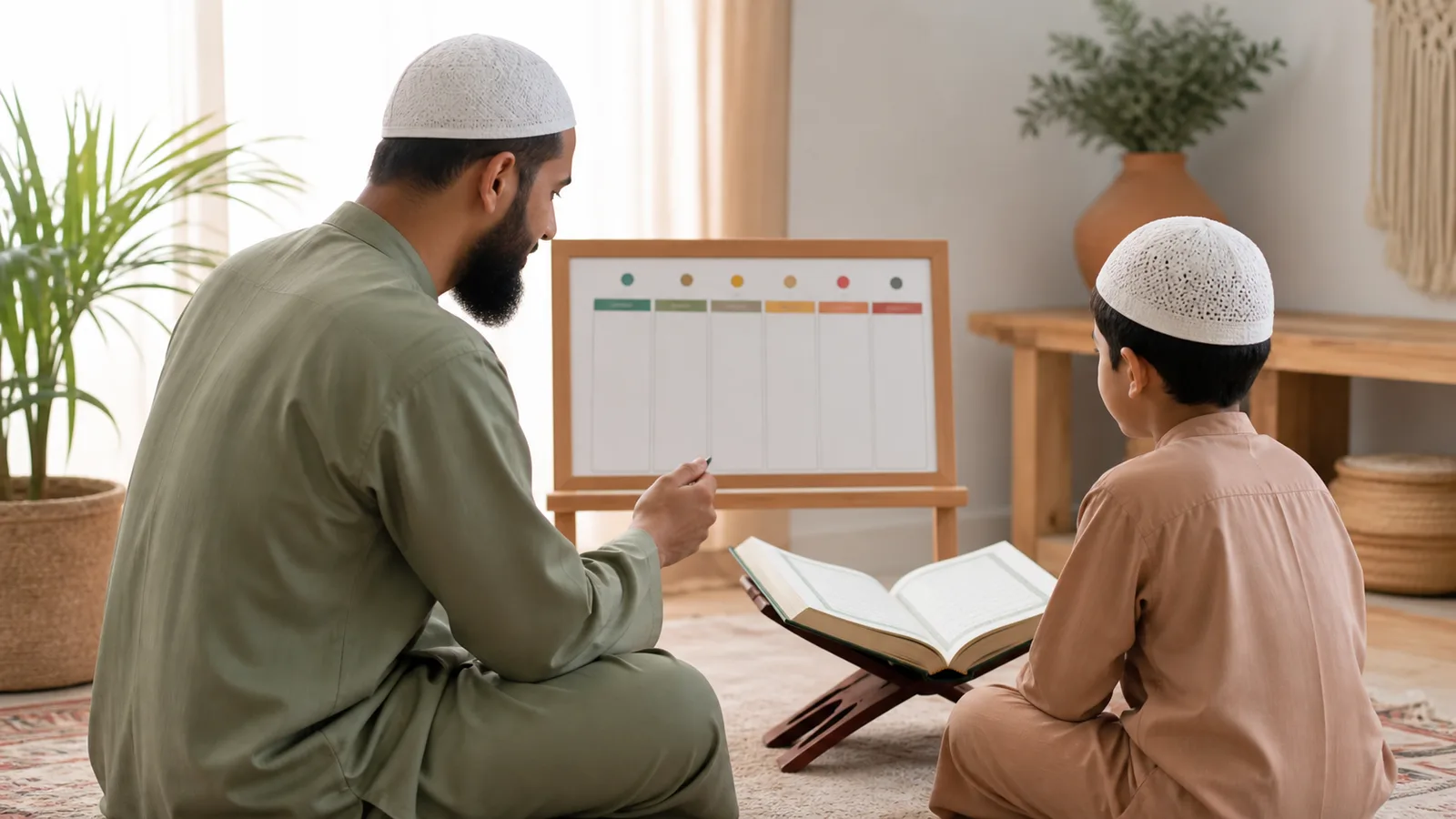
There is no single best age to start Hifz. The better question is whether a child is ready for regular, accurate memorisation and revision. Some children can begin short, structured portions in the early school years; others benefit from strengthening reading and attention first. Starting later with a stable method is better than starting early with pressure and weak retention.
Age is only one part of readiness
Memory can be strong in young children, but Hifz also asks for listening, pronunciation, routine and revision. A child may memorise a rhyme quickly while still lacking the patience to correct one letter repeatedly. Another may be older and slower at first but capable of understanding a schedule and taking responsibility for it.
Look at the whole child: reading ability, speech, attention, willingness, sleep, school commitments and response to correction. Our broader guide to the best age to start Quran classes covers the stages before formal memorisation.
Before age five: build familiarity
For most very young children, listening, loving repetition and recognising short surahs are enough. Let them hear careful recitation, repeat brief phrases and associate Quran time with warmth. There is no need to turn every listening moment into a test.
If a young child happily retains a short surah, that is valuable. It does not require committing to a full Hifz timetable. Keep sessions playful and brief, and stop while attention is still intact.
Ages five to seven: reading foundations and short portions
Many children at this stage can follow a teacher, repeat accurately and work through a reading primer. Formal work should remain short. If letters and vowel marks are uncertain, prioritise a Noorani Qaida course. Memorising through imitation can continue, but the teacher should watch for errors that sound fluent only because they are familiar.
A suitable plan may involve short surahs, a few words at a time, and frequent revision. The aim is to learn the habits of Hifz: careful listening, accurate repetition and returning to yesterday’s work.
Ages eight to eleven: a common window for structure
Many children now have stronger reading, longer attention and enough independence for a three-part routine. They can understand why new memorisation must be balanced with recent and older revision. This can be a productive time to begin a formal programme, but school and family life still set the pace.
Use the sabaq, sabqi and manzil method from the beginning. A child who learns revision as part of Hifz does not later experience it as a penalty for forgetting.
Twelve and older: motivation becomes central
Older children can plan, understand meaning at a deeper level and take more ownership. They also have heavier schoolwork and clearer preferences. Include them in decisions about timing and pace. Starting in the teenage years is not “late”; it simply needs a schedule designed for the life they actually have.
An older beginner may move more carefully than a small child but often notices patterns, diagnoses weak passages and revises deliberately. Those are serious advantages.
Five signs your child may be ready
- They can attend to a short lesson and accept gentle correction.
- They can reproduce a phrase accurately after a model.
- They read at a level that will not plant constant errors.
- They can follow a small daily routine on most days.
- They show willingness, even if enthusiasm naturally rises and falls.
Readiness does not mean perfect discipline. It means the routine can be sustained without an adult forcing every repetition.
Signs to strengthen foundations first
Pause the push toward formal Hifz if the child guesses at most words, becomes distressed by ordinary correction, has no space around school and sleep, or forgets every new portion because no revision system exists. A term spent improving Quran reading fluency may save years of correcting memorised mistakes.
Why finishing-age targets often backfire
A promise to “finish by ten” or “complete before secondary school” turns a living practice into a deadline. The child cannot control illness, school changes, teacher availability or the increasing weight of revision. A target may help planning, but it should never justify insecure portions or shame.
The honest timeline depends on daily quantity and, more importantly, retention. Our guide to how long memorising the Quran takes shows why revision changes the arithmetic.
What matters more than starting age
Accurate first learning
An error corrected before memorisation is cheap; an error repeated hundreds of times becomes stubborn.
A teacher who listens
Recordings provide a model, but they do not hear the child. Live feedback matters.
A written revision rota
Every memorised portion needs a route back into the week. The article on Hifz for children gives parents a practical framework.
A pace the family can protect
The best schedule is not the most ambitious one. It is the one that survives ordinary school weeks.
How to make the decision
Ask a qualified teacher to assess a short reading, listening accuracy and attention. Request a trial portion, then watch what remains the next day. That evidence is more useful than an age chart. A good teacher may recommend formal Hifz, a reading phase, or a mixed plan of short-surah memorisation and Qaida.
Our one-to-one children’s classes can be adjusted to the child rather than an age group. See how lessons work, or book a free trial for a readiness assessment and a realistic next step.
Learn the Quran with a teacher by your side
Live one-to-one classes for children and adults. Your first class is free.
Book a free trial class