
Of all the subjects now taught over a video call, Tajweed has the weakest case on paper. Languages and mathematics do not depend on a teacher hearing exactly where the back of your tongue meets your soft palate. Tajweed does. The doubt is well placed, and it deserves stating at full strength before anyone tries to answer it.
This article is published by an online academy, which is a reason to read it sceptically rather than skip it: the objection below is one we must answer honestly for our teaching to be worth anything.
The objection, stated fairly
Tajweed is not a body of information. A student can memorise every rule in a fortnight and still recite poorly, because the rules describe sounds the mouth has never made. What changes recitation is a qualified ear stopping you at the letter you got wrong and making you say it again until it is right.
That correction has been handed on face to face for fourteen centuries, in an unbroken chain of people rather than an archive of books. The tradition's own term for it is mushafahah — learning from the lips — and it is deliberately physical. Our article on what Tajweed is and why it matters covers the rules themselves.
So the objection runs: put a microphone, a connection and a loudspeaker between the reciter and the ear, and you are no longer doing mushafahah, only approximating it. Anyone who has sat through a call where a voice turned metallic knows how easily that link degrades. It is a serious argument, and asserting that technology has moved on does not answer it. What happens in a lesson does.
What actually travels down the line
Start with the medium. Tajweed lives almost entirely in sound, and sound is the one thing a call is built to carry. Over a decent line a trained ear can tell a heavy letter from its light twin, hear whether a nasal sound is held, and catch a lengthening cut a beat short.
Then consider where the microphone sits. A headset microphone is a few centimetres from your mouth. A teacher across a desk is a metre away, and in a hall where several students recite at once, that teacher's ear is picking one voice out of many. That filtering is skilled work, but it costs something, and an online teacher never has to do it.
The claim is not that a call beats a room, only that the comparison is far closer than it first sounds.
What is genuinely harder on a screen
The teacher sees less of you
No teacher anywhere can see inside your mouth: the tongue positions most rules turn on are invisible across a desk exactly as through a camera, which is why correction is made by ear in both settings. But what is visible — how far the jaw opens, whether the lips round, whether the mouth is barely moving — reads more easily from a seat beside you than from a camera angled at your forehead. Sit square to it, with your face in frame.
The positions themselves — which part of the tongue, throat or lips makes each letter — are set out in our guide to the 17 makharij of the Arabic letters.
Poor audio damages a Tajweed lesson more than any other
A patchy connection in a mathematics lesson costs you a repeated sentence. In a Tajweed lesson the missing fragment is the subject itself. Cheap microphones thin out breath sounds, which is where several letters live; noise cancellation meant for keyboard clatter can treat a breathy letter or a concealed nasal sound as noise and delete it; an unstable line chops up the very durations a lengthening rule is measured in. No teaching skill repairs that, and it is the commonest reason an online Tajweed lesson underperforms.
Very young children are harder to hold
A child of four or five gives attention to a person in the room more readily than to a screen. Lessons at that age do work online, but only kept short, with a parent nearby at first and a teacher used to small children. That is a genuine advantage of a class a child walks into.
What is genuinely better online
None of these is a convenience. Each changes how much correction a student receives.
One-to-one is the standard, not the upgrade. A mispronounced letter is fixed by saying it correctly, aloud, many times, with somebody stopping you every time you do not. A group class necessarily shares one ear among many students — arithmetic, not a criticism of teachers doing a great deal with limited hours. A one-to-one online Tajweed course spends nearly the lesson on the one voice being corrected.
Lessons can be more frequent. Pronunciation is a physical habit, and habits answer to repetition spread across the week rather than piled into one sitting. Remove the round trip and four short lessons a week becomes realistic where one was the ceiling, which is why our lesson plans and rates are built around short, frequent sessions.
The teacher is chosen on qualification, not on distance. Whether a specialist in recitation happens to live near you is mostly luck. Online that constraint disappears: our teachers are screened for recitation, Tajweed knowledge and teaching ability, and many hold an Ijazah, a formal certification to teach.
You can choose the gender of your teacher. Tajweed is learned by reciting aloud, repeatedly, at full voice. A student who feels uncomfortable recites quietly and hedges, which is exactly what stalls progress. For many sisters, and for parents of daughters, the choice is a requirement rather than a preference, which is why our female Quran teachers are listed separately.
The four things that actually decide it
Rank the variables honestly and format does not come near the top.
- The teacher's qualification. Someone whose own recitation is unsound cannot correct yours, and a habit learned wrongly takes far longer to unpick than to form.
- Genuine one-to-one attention. Not the class size on a brochure, but the minutes each week in which you are reciting and being corrected.
- Consistency. Twenty minutes four times a week overtakes two hours once a fortnight, reliably.
- Audio quality. The one item here that in-person study gets for free, and the cheapest of the four to put right.
Get all four right and the lesson works over a call; get any of the first three wrong and it will not work in a room either.
Getting the most out of an online Tajweed lesson
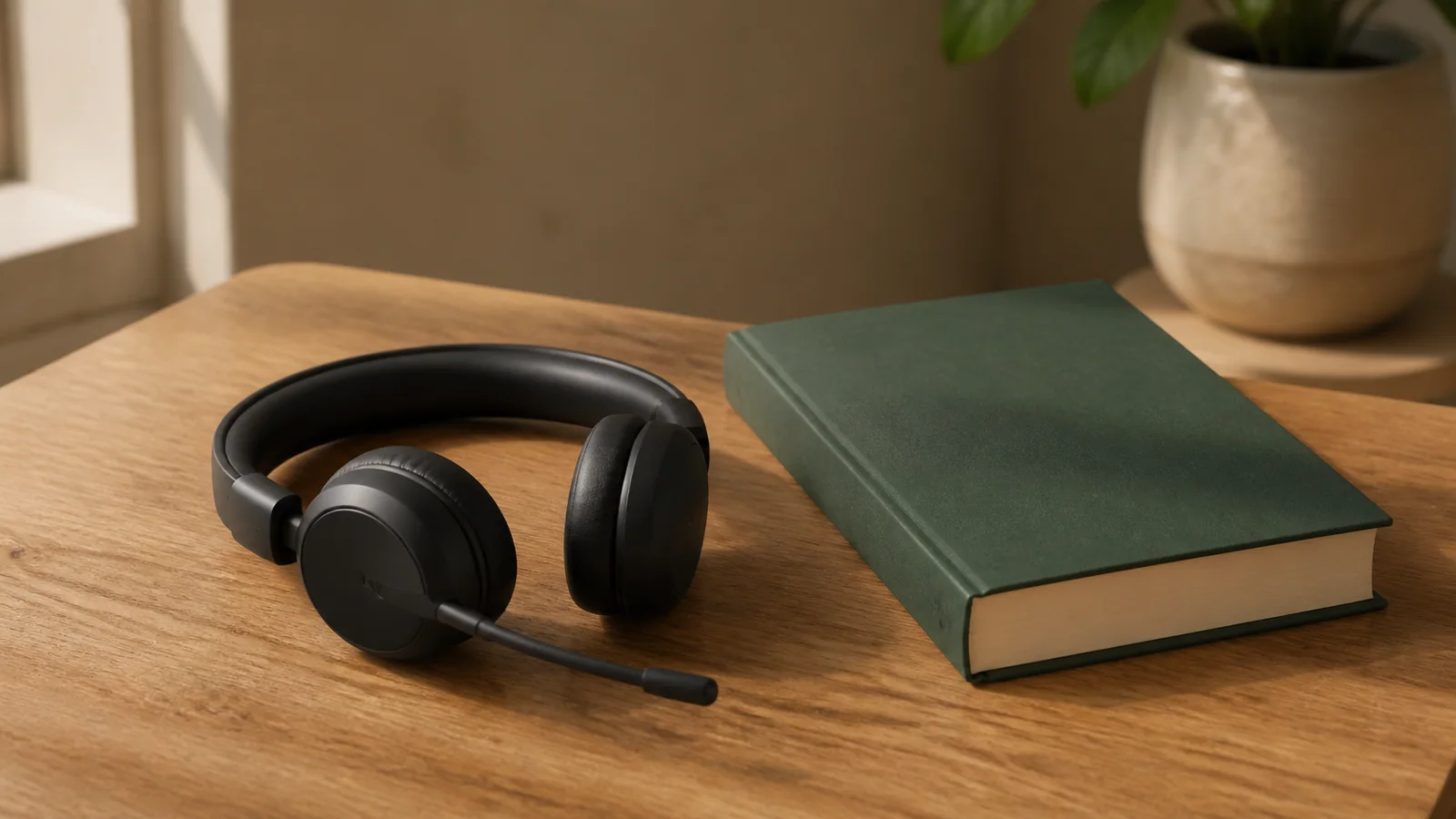
- Use headphones with a microphone rather than your laptop's speakers and built-in microphone. Speakers played into a room create an echo the software then fights, and a microphone a foot from your face catches everything except the detail that matters. It is the single largest improvement most students can make.
- Sit somewhere quiet. The more background noise there is, the harder noise cancellation works, and the more of your recitation it strips out with it.
- Recite at your normal speaking volume. Nervous students whisper, and no microphone restores what was never really said: the breath, the nasal sound and the bounce do not survive a whisper.
- Ask for a slow demonstration, then one at pace. The same word at half speed and again at full speed shows you which part of your mouth is meant to move, and no teacher minds repeating it.
- Recite aloud between lessons. The lesson corrects; the week in between makes the correction stick.
An honest verdict
Yes — you can learn Tajweed online, properly, to a standard that holds up when you recite in front of somebody. But that depends entirely on the conditions above: a qualified teacher, sustained one-to-one correction, regular short lessons, and audio good enough to carry the detail. Strip out one and the answer changes.
The other half deserves saying just as plainly. A poor online teacher is worse than a good local one, and no amount of convenience closes that gap. If you have an excellent teacher at your masjid or madrasah and your recitation is improving, that is not a problem in search of a solution. Plenty of families run both, and our wider comparison of online and in-person Quran classes takes that choice apart.
If you are undecided, the test costs half an hour. Book a free trial lesson, put on a headset and recite for a teacher who will tell you where you actually stand. If it suits you, a structured Tajweed course carries it forward, and our page on how the lessons run explains what follows the trial.
Learn the Quran with a teacher by your side
Live one-to-one classes for children and adults. Your first class is free.
Book a free trial class