
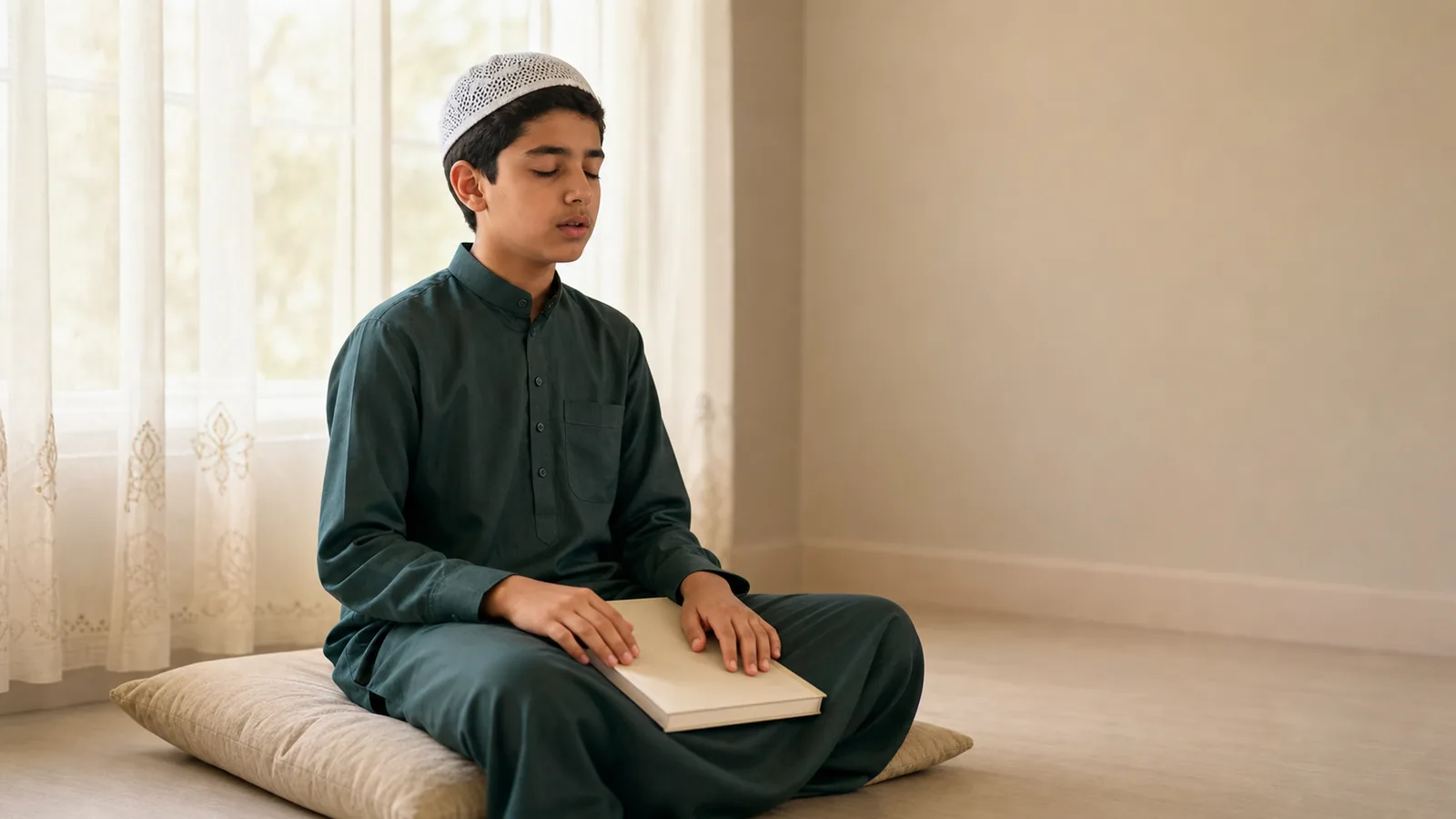
The short surahs to learn first are Al-Fatihah, then the three closing surahs of the Quran, then a handful of the very short chapters near the end of the final juz (one of the thirty sections the Quran is divided into). They are commonly recited in prayer and short enough to hold in memory while you are still learning to read. This article suggests an order, explains the reasoning behind it, and describes a method that works for a new Muslim or any adult who can read little or no Arabic yet.
Why start with these and not with the beginning
New learners sometimes assume they should open the mushaf (the printed Quran) at the front and work forwards. The second surah, Al-Baqarah, is the longest in the Quran, so that approach stalls quickly. The chapters at the end are the opposite: a few lines each, with short ayat (verses) and a rhythm the ear picks up easily. They are the surahs most Muslims recite in their daily prayers, so every one you learn is used immediately rather than filed away.
The reason to start with Al-Fatihah is different. It is the opening surah, commonly recited in every unit of prayer, and its seven ayat carry most of the sounds the rest of the Quran will ask of you. Our guide to Surah Al-Fatihah walks through its meaning and the pronunciation points a teacher checks first.
A suggested order, and why
Teachers vary in the exact sequence, and yours may reorder these for good reasons. This order goes from shortest and most used towards slightly longer:
- Al-Fatihah (1): first, because it is recited most.
- Al-Ikhlas (112), Al-Falaq (113), An-Nas (114): four to six ayat each, often learnt as a group of three, and among the surahs most commonly recited in prayer.
- Al-Kawthar (108): three ayat, the shortest surah in the Quran.
- Al-Asr (103): three ayat with a compact message about time, faith and patience.
- An-Nasr (110): three ayat.
- Al-Kafirun (109): six ayat with repeated phrases that help memory.
- Al-Ma'un (107), Quraysh (106), Al-Fil (105): four to seven ayat each.
- Al-Qadr (97) and At-Tin (95): a stretch goal, slightly longer and with a few new sounds.
Every surah here fits on a single page, and most fit in a few lines. The grouping of 112 to 114 at the top is deliberate: they share a rhythm, and many people learn all three in the first fortnight.
Learn by ear first, and learn to read alongside
An adult who cannot yet read Arabic script has two jobs that run in parallel. The first is to learn the letters and their sounds through a Noorani Qaida course, which usually takes a few months at two or three classes a week. The second is to learn these surahs by listening, which can start today.
Learning by ear before reading is normal and it is not cheating. For most of Islamic history the Quran was passed from mouth to ear, and a child in a Muslim home learns Al-Fatihah long before the alphabet. What matters is that your ear copies a reliable source and that a teacher checks the result, because the ear misses things. It hears "s" where a heavy ص was recited, and it shortens a long vowel without noticing.
Your ear will carry the surah into your memory; your teacher makes sure it carries the right sounds.
A method that fits into a working week
The method below assumes fifteen to twenty minutes a day. The steps are simple and the order matters:
- Pick one reciter. Choose a clear, measured reciter and stay with the same voice for all of these surahs, so the rhythm you copy is consistent.
- One ayah at a time. Play the ayah, pause, repeat it aloud, and do this until you can say it without the recording. Only then add the next ayah and join the two.
- Know one line of meaning. Learn a single sentence for each surah, such as "Al-Ikhlas describes the oneness of Allah" or "Al-Asr says that people are at a loss except those who believe, do good, and urge one another to truth and patience". It anchors the surah and makes the recitation feel like speech instead of sound.
- Revise in prayer. Many Muslims rotate the surahs they have memorised through their daily prayers. Reciting a surah several times a day, from memory, is the most reliable revision there is.
- Recite to a teacher weekly. One live session on a private video call, where a teacher stops you on the sounds your ear missed, is worth more than hours of unchecked repetition.
Adults who have worked through our beginner Quran classes often describe the moment the two jobs meet: they open the mushaf and recognise, in print, a surah they already know by heart. From that point reading accelerates, because the eye is matching letters to sounds it already owns.
Guidance for new Muslims
If you have recently accepted Islam, the pressure to learn everything at once is real, and most of it is self-imposed. Al-Fatihah and one of the three short surahs at the end are enough to begin with, and the rest can follow at a steady pace. Nobody expects a revert to recite like a lifelong Muslim in the first month, and a good teacher will tell you so.
Our online Quran classes for reverts assume no background at all: no Arabic, no prior exposure, no familiarity with the vocabulary. A teacher of the same gender is available on request, and the first class is spent finding out what you already know and what you would like to reach first.
What comes after these surahs
The surahs in this list all sit in the last of the thirty juz, known as Juz Amma (named after the first word of Surah An-Naba, which opens it). Once you hold ten or twelve of them, the natural next stage is to work through that whole section in order. Our article on how to memorise Juz Amma lays out a plan for it, and by then you will have the reading skills to follow the text as well as the sound.
From there, some learners move on to longer surahs and a formal Hifz programme; others are content to read fluently and understand what they read. Both are good outcomes. The short surahs are the foundation for either.
Frequently asked questions
Which surah is the easiest to memorise?
Al-Kawthar, with three short ayat, is the shortest surah in the Quran and is usually the quickest to learn. Al-Ikhlas is almost as short and is recited so often that most learners absorb it within days. Ease also depends on sounds: a surah with fewer heavy letters is easier for an English speaker to say correctly.
How many surahs should I learn before I start reading Arabic?
There is no need to wait. Begin listening and memorising on the first day, and begin the Qaida at the same time. The two strands support each other: the surahs give you words you already know to recognise on the page, and the Qaida gives your ear the letter distinctions it was missing.
Can I learn the surahs from transliteration?
Transliteration in Roman letters can help you remember the sequence of words, but it cannot show you which "s" is heavy or where a vowel is long, because English letters do not carry that information. Use it as a memory aid alongside a recording, and treat the teacher's correction as the final word.
How long does it take to learn all of these?
Working fifteen minutes a day with a weekly correction session, many adults hold the first four within a month and the full list within three to four months. Speed matters far less than accuracy. A surah learnt slowly with correct sounds is more useful than five learnt quickly with mistakes that later have to be unlearnt.
Is it acceptable to recite a surah before I know its meaning?
Many Muslims recite surahs before they understand every word, and learning the meaning afterwards is a normal path. A one-line summary of each surah is quick to learn and gives the recitation a sense of purpose. Questions about what any act of worship requires are best taken to a qualified scholar rather than a blog.
Learn your first surah with someone listening
Listening and repeating will take you a long way, but the sounds your ear cannot hear need another person's ear. Our Quran classes for beginners pair you with a live teacher on a private video call who corrects one ayah at a time, at the pace you set.
Start with a free first lesson, with no card required, and bring whichever surah you have been listening to. By the end of it you will know exactly which sounds to work on next.
Learn the Quran with a teacher by your side
Live one-to-one classes for children and adults. Your first class is free.
Book a free trial class