
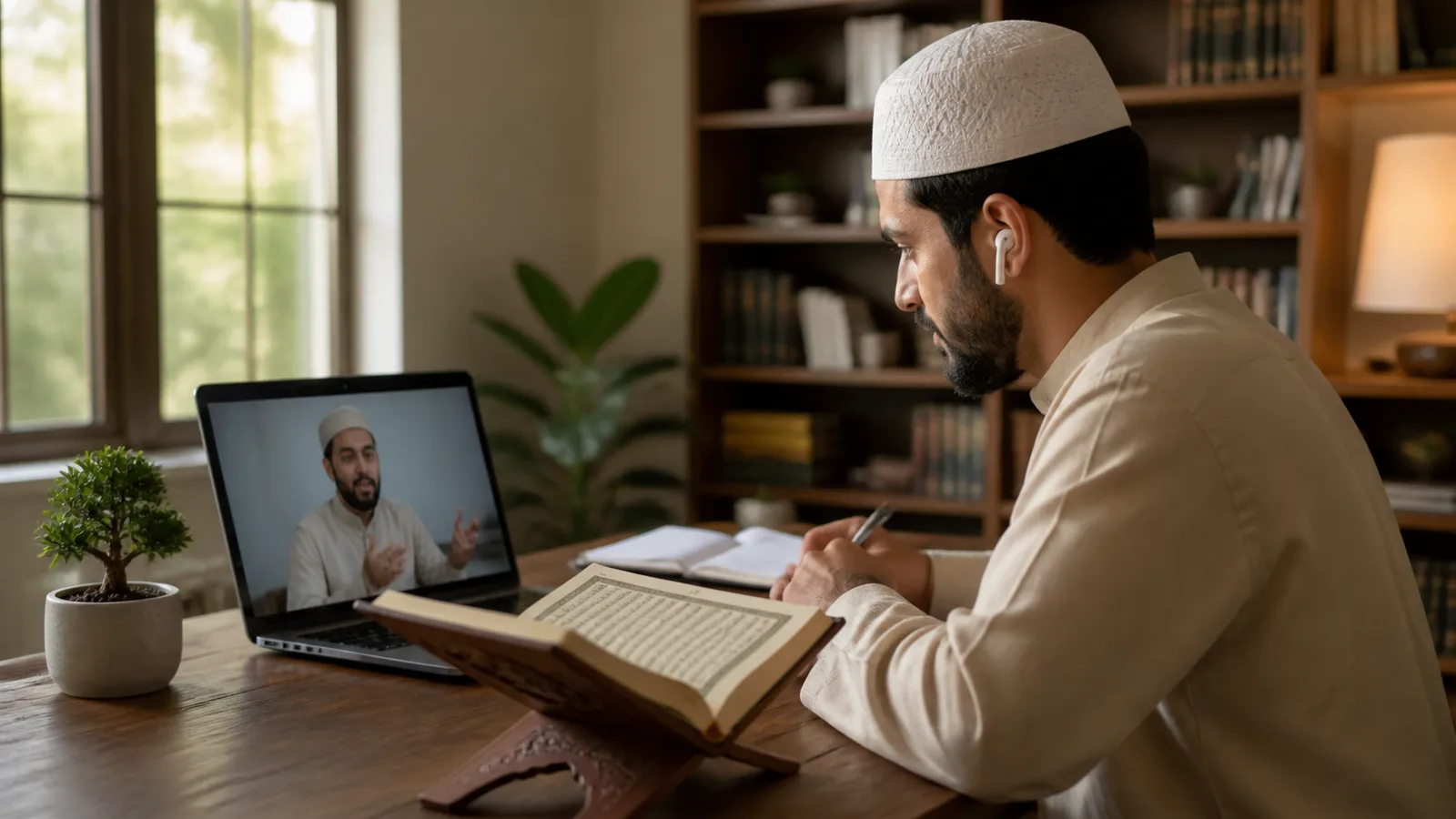
Online Quran classes can be effective because the essential parts of a lesson can happen live: the student recites, the teacher listens closely, correction happens immediately, and the student tries again. The screen is not the teaching method. The quality of attention, explanation, practice, and follow-up is what determines whether the format works.
They are not automatically effective. A poor connection, passive recorded content, an unsuitable teacher, or irregular attendance can make online study frustrating. The right question is therefore not simply “Does online learning work?” but “What conditions make it work for this learner?”
What an effective Quran lesson needs
Quran reading and recitation are heard skills. A learner needs a model to imitate and a knowledgeable listener who can distinguish between a correct sound and a near miss. In a live class, a teacher can ask for one letter, word, or verse again, demonstrate the point, and listen to the new attempt.
That feedback loop is possible online when audio is clear and the class is genuinely interactive. It is much harder in a recorded course where nobody hears the learner. Videos can explain a rule, but they cannot know whether the viewer applied it. This is why our online lesson process centres on live teaching rather than a library of recordings.
Where online lessons can be especially useful
Access to a suitable teacher
A local teacher may be excellent, but not every family has the right course, language, teaching style, or schedule nearby. Online learning widens the choice. A student looking for a female Quran teacher, a child-friendly tutor, or focused Tajweed support can look for the appropriate match rather than accepting the only available slot within travelling distance.
Private correction time
In a one-to-one lesson, the scheduled attention belongs to one learner. The teacher can spend several minutes on a recurring letter without holding up a class, or move quickly through material the student already knows. That makes the format useful for mixed starting points. Read our fuller comparison of private and group Quran classes if class size is part of your decision.
A routine that avoids travel
Removing a journey can make short, regular lessons practical around school or work. The saved travel does not create progress by itself, but it can remove one reason for missed classes. A learner can finish a lesson and use the same desk, Mushaf, and notes for a short review.
Where the format can struggle
Weak or distorted audio
When sound cuts out, correction becomes guesswork. Device speakers may be adequate, but headphones with a microphone often make quiet distinctions easier to hear. Test the setup before class, close noisy applications, and sit near the router if the connection is unstable. The teacher should say when the audio is not good enough to judge a sound.
A learner who cannot yet work independently
A very young child may need a parent to open the call, position the book, and help them remain seated. The parent should support the environment without answering for the child or correcting over the teacher. If a child needs constant physical redirection, a shorter lesson or an in-person arrangement may be a better current fit.
Passive teaching
A long lecture over video is still a long lecture. Effective lessons require the learner to read, answer, repeat, and demonstrate. If most of each class is spent watching the teacher talk, ask how practice and correction are being built into the time.
No practice between lessons
A teacher can identify the next small step, but cannot repeat it on the learner’s behalf during the rest of the week. Five or ten focused minutes between classes may be more sustainable than a rare long session. The exact routine depends on age and course, but some return to the lesson material is necessary.
Effectiveness for different goals
Beginners and Qaida students
Beginners benefit when the teacher can share a clear page, point to the current letter, demonstrate it, and listen to repetition. The pace must stay slow enough to secure foundations. Our Noorani Qaida course is structured around that progression from individual letters to joined reading.
Tajweed students
Tajweed can be taught online when the learner’s recitation is clearly audible and the teacher requires application, not only rule memorisation. Some mouth positions are easier to demonstrate on camera than from across a room; other subtle distinctions depend heavily on clean sound. A live Tajweed lesson should combine explanation, modelling, listening, and repeated correction.
Hifz students
Memorisation lessons can work well online because recitation, error marking, and revision checks are all conversational. The difficulty is rarely the call itself; it is maintaining new memorisation and old revision outside it. Students need a realistic routine and honest reporting when a portion is not ready.
Children
Children usually need shorter instructions, visible progress, and a teacher who changes activity before attention disappears. Parents should consider temperament rather than assuming every child of the same age will respond alike. The guidance on online Quran classes for kids explains how individual pacing can help.
How to judge progress fairly
Do not measure only pages completed. A student can rush through pages while preserving the same errors. Useful signs depend on the goal:
- A beginner recognises letters more reliably and needs fewer prompts.
- A reader pauses less and corrects familiar mistakes independently.
- A Tajweed student applies a studied rule during normal recitation.
- A Hifz student retains older portions as new material is added.
- A child begins class willingly and can explain what to practise next.
Ask the teacher for one or two current priorities rather than a vague “doing well”. After several weeks, those priorities should either improve or be replaced by more specific next steps.
How to make an online class work better
- Protect the time. Treat it as a real appointment, with the book and device ready beforehand.
- Improve the sound. Use a quiet room and test the microphone rather than assuming the teacher can hear every distinction.
- Keep materials consistent. Use the same Qaida or Mushaf edition when possible so page references stay clear.
- Write down one correction. A short, specific practice target is easier to remember than a whole lesson.
- Speak up about fit. If the pace, language, or teaching style is not working, ask for an adjustment early.
Online or in person: which should you choose?
Choose the setting in which the learner can attend consistently, be heard clearly, and receive appropriate correction. In person may suit a child who needs hands-on classroom structure or a family with unreliable internet. Online may suit a student who needs a particular teacher, private attention, or a schedule unavailable locally.
You do not need to settle the question in theory. A trial lesson provides concrete evidence: Was the sound clear? Did the teacher identify the level? Did the learner participate? Did the next step make sense? Our guide to what happens in a first online Quran class can help you prepare.
Frequently asked questions
Can a teacher correct makhraj through a screen?
Often, yes, when the microphone is clear and the teacher can ask for focused repetition. If audio is distorted, a responsible teacher should address the setup rather than pretending to hear precisely.
Are recorded Quran courses enough?
They can introduce concepts and support revision, but they cannot hear your recitation. For reading and Tajweed, live correction supplies something a recording cannot.
How often should online lessons happen?
The right frequency depends on the learner’s goal, age, attention, and practice time. A sustainable schedule followed consistently is usually better than an ambitious one repeatedly missed.
Should a parent attend a child’s class?
A parent should supervise the setup and remain appropriately available, especially for a young child. The level of presence can reduce as the child demonstrates independence and the academy’s safety arrangements are clear.
If you want to test the format with your own device and schedule, book a free trial class. Use it to assess sound, teacher fit, participation, and the proposed learning path before deciding.
Learn the Quran with a teacher by your side
Live one-to-one classes for children and adults. Your first class is free.
Book a free trial class