
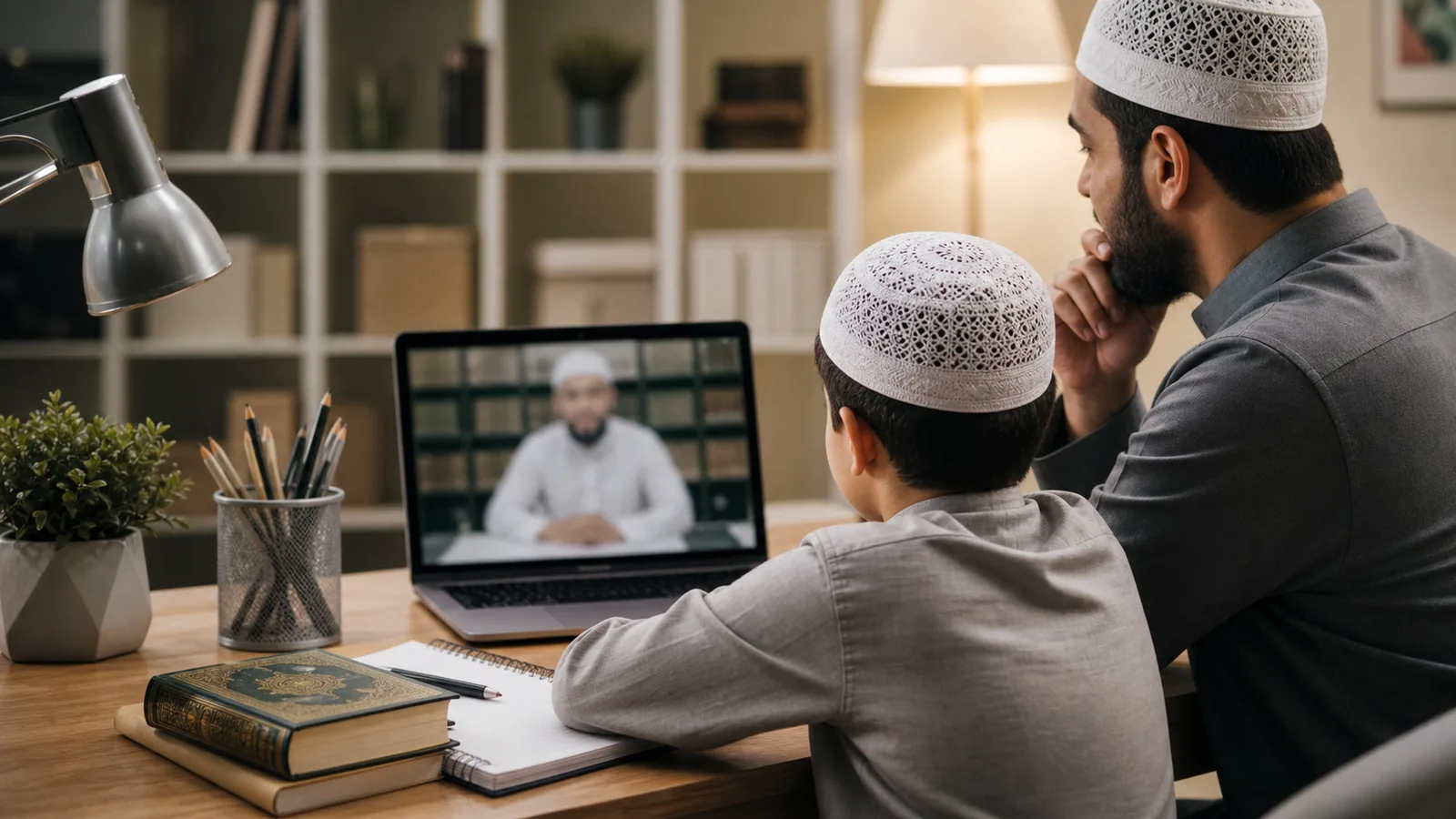
Choosing a Quran teacher for your child is not only a question of who recites beautifully. The teacher needs sound knowledge, but they also need to notice how this child learns, correct without humiliating, communicate with parents, and create enough structure for progress to continue between lessons.
A polished profile cannot answer all of that. The best decision comes from checking credentials, asking practical questions, observing a real lesson, and treating the first few weeks as a genuine trial of the match.
Clarify what your child needs first
Before comparing teachers, identify the job. A five-year-old meeting Arabic letters needs a different skill set from a fluent twelve-year-old beginning Tajweed or a child undertaking Quran memorisation. Write down your child's current level, previous materials, main difficulty and realistic weekly availability.
If you cannot assess the level yourself, ask for an initial reading assessment rather than guessing. A careful teacher should be able to explain what they heard and propose a starting point. They should not promise a completion date before meeting the student.
Check Quran knowledge and teaching ability separately
A credential, ijazah or history of study can provide evidence of a teacher's own learning. Ask what they studied, with whom, and what the qualification covers. Do not assume every impressive title means the same thing; a teacher should be comfortable explaining it plainly.
Then ask about teaching. How do they introduce Arabic letters? How do they correct a child who keeps repeating the same error? What changes for a six-year-old versus a teenager? How do they decide when a student is ready to move from Noorani Qaida to the Mushaf? Knowledge of recitation and the ability to teach children are related, but distinct.
Listen to the way correction is given
Quran learning necessarily involves correction. The issue is whether correction tells the child what to do next. “Wrong” repeated ten times creates tension but no new information. A useful correction isolates the sound, demonstrates it, gives the child another attempt, and acknowledges when the attempt changes.
The teacher should preserve dignity. Sarcasm, comparisons with siblings, threats and public embarrassment have no place in a lesson. Firmness can be calm and specific: sit back down, look at this word, try the line once more. A child should not have to fear the teacher in order to take the work seriously.
Look for a pace built around mastery
Fast page turnover is easy to display, but it can hide guessing. Ask what has to be secure before new material is added and how older work is reviewed. In memorisation, ask how the teacher balances new portions with revision. In reading, ask whether the child can decode unfamiliar words rather than only repeat a familiar page.
Progress should be visible in skills: fewer prompts, more accurate letter recognition, steadier recitation, stronger recall. It should not be measured only by books completed.
Ask about communication with parents
You need enough information to support learning without sitting inside every lesson. A teacher should be able to report what was covered, name one or two priorities, and give a realistic practice task. “Revise everything” is not a plan.
Agree how concerns will be discussed and how often progress is reviewed. For younger children, clarify whether a parent should remain nearby. For teenagers, protect an appropriate degree of independence while keeping safeguarding and accountability clear.
Check safeguarding and professional boundaries
For online or in-person teaching, ask who manages scheduling and communication, whether messages go through a parent's account, and what supervision or reporting process exists. A child should not be expected to manage private contact with an adult teacher. Parents should know when and where every lesson takes place.
In an online lesson, keep the device in an appropriate family space where practical and know how to raise a concern. In person, understand the setting and who else is present. A professional teacher or academy will welcome clear safeguarding questions rather than treating them as distrust.
Consider language, gender and personality
The best explanatory language is usually the one your child understands most comfortably. Shared heritage language can be valuable, but it should not become a barrier if the child thinks and asks questions in English.
Some families prefer a male or female Quran teacher, especially as children grow older. State that preference early. Personality matters too: a lively young child may need a teacher with warm energy and quick transitions; an anxious child may need an especially measured tone; a focused teenager may prefer a concise, demanding teacher.
Questions to ask before enrolling
- What do you assess in the first lesson?
- Which Quran or Qaida do you use, and why?
- How do you teach a sound the child cannot yet produce?
- How much home practice do you expect at this age?
- How do you review earlier material?
- What feedback will parents receive?
- What happens if the child and teacher are not a good fit?
- How are scheduling, communication and safeguarding handled?
Clear, modest answers are more reassuring than guaranteed outcomes. Learning depends on the child's starting point, attendance, practice and response to teaching. No responsible teacher can promise fluency or Hifz on a fixed date without understanding those factors.
What to observe in a trial lesson
Notice who is doing most of the work. Explanation is necessary, but a Quran lesson should include substantial time in which the child reads, repeats or recalls while the teacher listens. Watch how long the child waits, whether instructions are understood, and what happens after an error.
Afterward, ask the child open questions: What did you learn? What felt easy or difficult? What was the teacher like when you got stuck? Avoid asking only “Did you like it?” A good teacher may set challenging work; the important question is whether the challenge felt understandable and safe.
The teacher should also give you a useful summary: current level, first priority and recommended schedule. Compare that with what you observed.
Review the match after several weeks
One lesson shows tone; several weeks show a pattern. Look for willingness to attend, clarity about practice, and small but observable improvements. Your child does not have to be excited before every class, but persistent dread, unexplained tears, or a collapse in confidence needs attention.
Speak to the teacher before assuming the arrangement cannot improve. The time may be wrong, the pace may need adjusting, or home practice may be unclear. Our article on keeping children engaged in Quran lessons offers practical adjustments. If respectful discussion changes nothing, choosing another teacher is not failure.
Online or local?
A local teacher offers physical presence and may connect a child with the mosque community. Online teaching widens the pool beyond whoever lives nearby and can make language, gender and schedule preferences easier to meet. Neither format guarantees quality. Compare the actual teacher, lesson environment and consistency available to your family.
If you are considering remote study, our honest comparison of online and in-person Quran classes and the explanation of how a live online lesson works cover the trade-offs.
The right teacher helps a child become a learner
The strongest teacher-child relationship does more than move through a syllabus. The child learns how to listen to a correction, practise deliberately, notice an error, and return after a difficult session. Those habits outlast any particular book.
Take credentials seriously, but also take tone, communication, safeguarding and fit seriously. Meet the teacher before committing where possible. You can browse our teacher profiles and book a free trial class to assess the relationship in a real lesson rather than on a sales page.
Learn the Quran with a teacher by your side
Live one-to-one classes for children and adults. Your first class is free.
Book a free trial class