
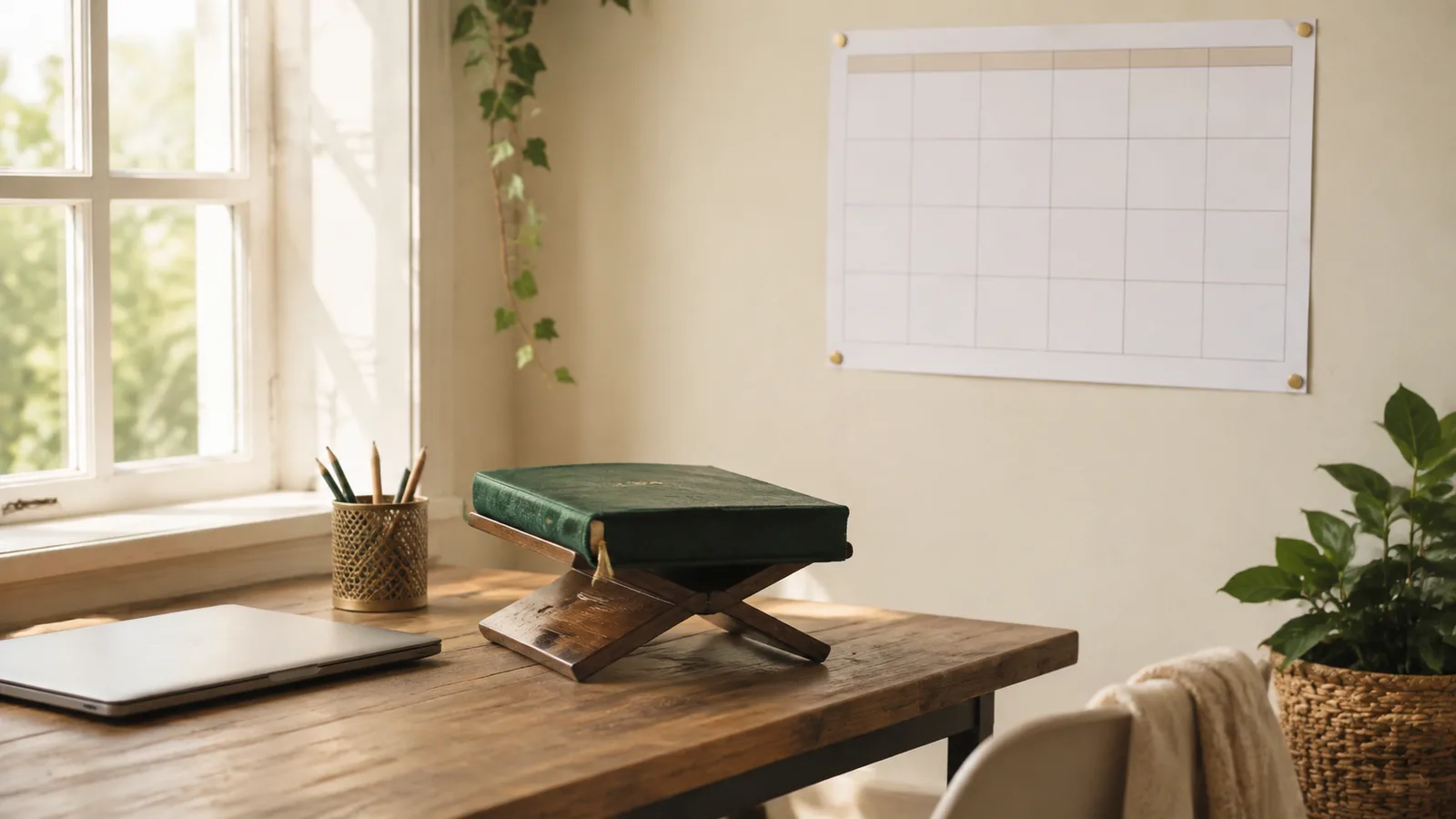
Quran classes for homeschoolers work best when Quran is timetabled as a fixed subject with its own teacher, in the same way a family might book a piano tutor or a language class. The parent co-ordinates the day; a live one-to-one teacher takes responsibility for reading, correction and memorisation. That division of labour stops Quran becoming the subject that waits until everything else is finished.
Timetable Quran as a fixed daytime subject
The most common difficulty homeschooling families describe is not a lack of commitment. It is the quiet assumption that Quran can be fitted in once the rest is done. By the time maths, reading, writing and a science experiment are finished, the child is tired, the parent is tired and the day has run out. Quran becomes the subject that is always about to happen.
The fix is structural rather than motivational. Put Quran on the timetable at the same time on the same days, and let it be a lesson with another person waiting on the other end of the call. A booked teacher is far harder to postpone than a good intention. Families who work through our guide to choosing the right number of Quran classes per week usually settle on two or three fixed sessions, then protect them the way they would protect a swimming lesson.
If Quran is the one subject with a fixed time and a teacher waiting, it becomes the one subject that is never skipped.
Homeschooling also gives you a choice most families do not have: the crowded window between the end of the school day and dinner is not your only option. You can take a mid-morning slot instead, when the child is fresh, the house is quiet and nobody is hungry. Place it first, before the child's attention has been spent, or straight after a break so the lesson begins with some energy. Ask the academy which daytime times are open in your time zone; a morning request is usually far easier to meet than an after-school one. Keep that slot fixed even when the rest of the timetable moves, so the child learns that Quran happens at ten o'clock and stops negotiating.
You are the co-ordinator, not the Quran teacher
Parents who teach every other subject at home often feel they ought to teach Quran as well. If your own recitation is strong and you enjoy teaching it, that is a real option. But Quran reading is a subject in which the sound of a letter has to be corrected by a trained ear in real time, and many parents who are confident with phonics or fractions are less sure about the difference between a heavy and a light letter.
Handing the teaching to a screened teacher does not remove you from the subject. You still own the timetable, the environment and the follow-through between lessons. You sit nearby for the first few weeks, then move to hearing distance. You ask what to practise and make sure it happens. That is the same role a parent plays in any tutored subject, and it is a demanding one in its own right.
In practice that means three habits. Sit within earshot for the first few weeks so you know what the teacher is asking for. Write down the practice task after each lesson, because a child rarely remembers it accurately. And raise anything you notice, such as a slot that always runs late or a sound the child avoids, rather than waiting for the monthly report to mention it.
Combine the Qaida, reading and memorisation strands deliberately
A home curriculum usually has strands within each subject, and Quran is no different. There are three:
- Qaida: letter recognition, correct sounds and joining letters into words, typically through the Noorani Qaida.
- Nazra: reading directly from the mushaf (the printed Quran) with increasing fluency.
- Hifz: memorisation, usually beginning with short surahs and building towards a structured Hifz programme if the family chooses that path.
A beginner works on one strand. Once reading is fluent, a one-to-one teacher can run two strands in the same lesson: ten minutes of new reading and ten minutes of memorisation review, for example. Because the class is private, the mix can change from week to week without waiting for a group to catch up. Tell the teacher which strands matter most to your family and let them set the proportions.
Decide early which strand you want to finish first rather than trying to move all three at once. A child who is still spelling out words in the Qaida gains little from memorising a page they cannot yet read, whereas a fluent reader can carry a memorisation strand comfortably. The teacher will tell you when a second strand can be added without slowing the first.
Records for the portfolio, audiences for the recitation
Many homeschooling families keep a portfolio, whether for their own peace of mind or because someone outside the home asks to see evidence of learning. Quran deserves a section in it like any other subject. The academy sends a monthly progress report for each student, and that report is the natural backbone of the section. Alongside it, keep a one-line log per lesson in your own hand: the date, the page or surah, and anything the teacher asked you to practise. Over a term the two together show a clear line of progress. Our guide to reading a Quran class progress report explains which details are worth copying into your own notes. When a course is completed, the certificate can be filed in the same place.
The portfolio records what the child can do; the family should also hear it. Children at school hear their peers reciting every day, while a homeschooled child may only ever read to a teacher and a parent. Recitation is meant to be heard, so build small audiences on purpose. A grandparent on a video call, a Friday evening family gathering, or a weekend circle at the masjid all give the child a reason to read clearly and a memory of being listened to.
Keep the audience kind and the piece short. A confident child will grow into longer passages; a hesitant one may need the gentler steps described in our article on helping a shy child read Quran aloud. The aim is not performance but the ordinary experience of Quran being part of family life, rather than a private lesson that ends when the call ends.
Frequently asked questions
Can Quran lessons be booked in the morning?
Yes. Tell the academy your preferred window when you book and it will look for a teacher who is available then. Daytime hours are worth asking about rather than assuming every lesson has to happen in the evening.
Do I need to know Arabic to homeschool Quran?
No. The teacher handles the Arabic; your job is the timetable, the environment and making sure practice happens. Many parents learn a good deal simply by sitting nearby during the early lessons.
How many classes a week suit a homeschool timetable?
Two or three fixed lessons work for most families, with short practice on the days between. Five suits a child who is memorising or who wants an intensive term, provided the rest of the curriculum still has room to breathe.
Can two homeschooled siblings share one lesson?
Each child is taught separately so the teacher can work at that child's own level. Back-to-back slots keep the household routine simple; our guide to online Quran classes for siblings covers the practicalities.
Can I use the monthly reports as portfolio evidence?
Yes. They record the current lesson, what was corrected and what is set for practice, which is exactly the kind of dated evidence a portfolio needs. Add your own brief log and the section is complete.
What if we already follow a set homeschool curriculum?
Quran sits alongside it as a separate timetabled subject rather than replacing anything. Share your term dates and holiday plans with the teacher so the lesson pattern can follow the rest of your year.
Add a Quran teacher to your home timetable
If you would like Quran to be the subject that always happens rather than the one that waits, start by finding out which daytime slots are open. Look at how our online Quran classes for kids are structured, then book a free one-to-one trial class at a time that fits your home day. There is no card to enter and no contract to sign.
Learn the Quran with a teacher by your side
Live one-to-one classes for children and adults. Your first class is free.
Book a free trial class