
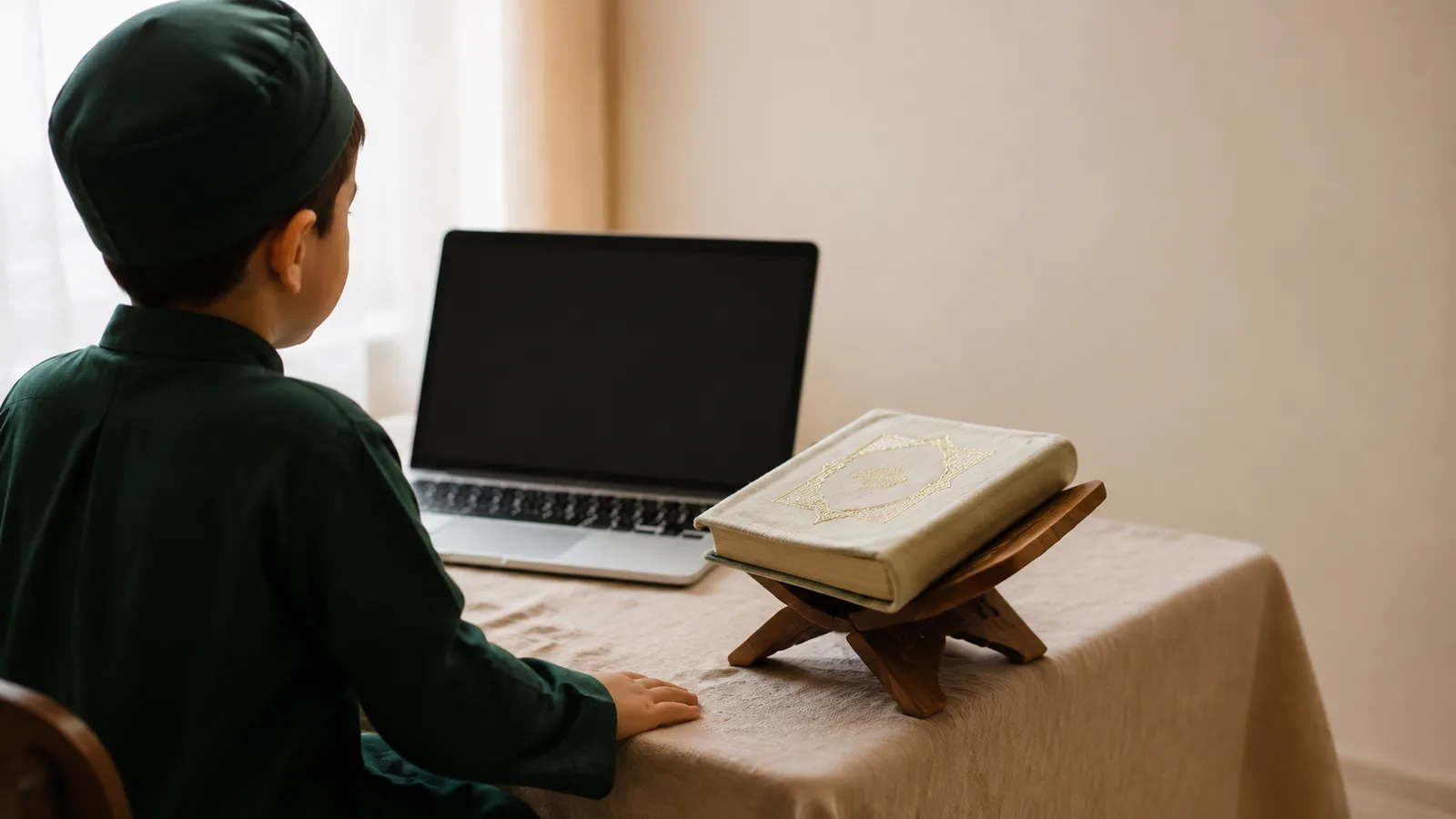
Tajweed for kids begins long before a child hears the word Tajweed. It starts the first time a teacher says a letter clearly and the child copies it back, and it grows through years of hearing correct recitation and imitating it. The named rules come later, once reading is fluent, and the teacher rather than the calendar decides when.
Tajweed is the set of rules for pronouncing each letter correctly and reciting the Quran the way it was transmitted. For an adult that sounds like a body of theory to study. For a child it is mostly an ear and a mouth being trained, and understanding that difference changes how a parent supports it.
Imitation comes before rule names
Children learn their first language without a single grammar lesson; they copy what they hear until it sounds right. Tajweed works the same way in the early years. A six-year-old can produce a properly heavy ra or a clean throat letter because the teacher said it and the child repeated it, without any idea that the sound has a name.
This is why a live teacher matters so much at the start. A child imitating a recording cannot be told that the sound was nearly right but the tongue was too far forward. A child imitating a teacher on a private video call hears the model, tries it, and is corrected within seconds, dozens of times a lesson. Our explainer on what Tajweed is and why it matters gives the background; this article is about how children actually absorb it.
Parents sometimes worry that a child who cannot explain a rule has not really learned it. For a young child the opposite is closer to the truth: a rule that is in the mouth but not yet in the vocabulary is exactly where Tajweed should be at this stage. The naming comes later and takes far less time once the sound is already there.
What is taught alongside the Qaida
A child working through the Noorani Qaida is learning Tajweed from the first lesson, even though nobody calls it that. The Qaida is arranged so that correct pronunciation is built in as the letters are learned. By ear and by imitation, a child typically picks up:
- Each letter from its correct makhraj (the point in the mouth or throat where the letter is formed), so that similar-sounding letters are kept apart from the beginning.
- Heavy and light letters, known as tafkheem and tarqeeq, recognised by sound long before the terms are introduced.
- The short vowels and the long vowels, including the natural lengthening of a madd (a stretched vowel sound).
- Sukoon and shaddah, the marks for a still letter and a doubled one, and how they change the rhythm of a word.
- The nasal hum called ghunnah, which a child copies from the teacher's voice; our guide to ghunnah explains where it occurs.
A child who finishes the Qaida with these sounds secure has most of practical Tajweed already in their mouth. What remains is vocabulary and the finer rules, and both are far easier to add to a clean foundation than to a rushed one.
When explicit rules are introduced, and the signs a child is ready
There is no correct age for starting formal Tajweed. The readiness test a teacher uses is fluency: can the child read a line of the mushaf without spelling out words, and with enough spare attention to think about how a sound is produced? Some children reach that point early in primary school, others much later, and adults reach it at every age.
Once reading is fluent, a teacher begins to name what the child is already doing and then adds the rules that imitation alone does not cover: the rules of noon sakinah and tanween, meem sakinah, the different lengths of madd, and qalqalah (the slight bounce on certain still letters). This is the content of a dedicated Tajweed course. The rules taught follow the transmission of Hafs from Asim, the most widely read; other transmissions differ in some details, and a teacher will say so where it is relevant.
If your child reads the line comfortably but the teacher keeps pausing at the same kinds of sound, your child is ready to learn what those sounds are called.
The signs are practical:
- They read a page of the mushaf at a steady pace without spelling out words.
- The teacher's corrections are now about rules and lengths rather than letter sounds.
- They ask why a sound is made a certain way, or notice when a reciter does something differently.
- They can hold attention for a full lesson and take a small amount of theory without losing interest.
- The teacher recommends it, which is the most reliable sign of all.
For children who are memorising, Tajweed usually runs alongside rather than before; our guide to Hifz for kids explains how the two fit together.
How the teacher corrects, and how you practise at home
Correction in a private lesson has a rhythm. The teacher lets the child finish the word or the phrase, models the correct sound once, asks for it back, and moves on if it is close enough. A stubborn sound is noted and returned to at the end rather than interrupting the flow every time it appears.
Good teachers also limit the number of targets. One or two sounds are the focus for a week; everything else is allowed to be imperfect for now. A child corrected on everything at once learns only that reading is dangerous. Because the class is one-to-one, nobody else hears the mistakes, which for many children is the difference between trying a sound and refusing to.
You do not need to know Tajweed to support it, and you should not correct sounds you are unsure of. Your role is listening. Ask the teacher what the target sound is this week and what it should sound like; many teachers will demonstrate it at the end of a lesson so you can hear it. At home, have the child read the assigned lines to you and simply notice whether the target sound appears.
Beyond that, let the child hear good recitation often: in the car, at bedtime, during prayer at home. The ear does most of the work in the early years, and a child who hears a surah recited well fifty times will start to reproduce it before anyone teaches the rules. Our article on the parent's role in online Quran lessons covers where to draw the line between supporting and teaching.
Frequently asked questions
At what age should a child start Tajweed?
Practical Tajweed starts with the first letter, at whatever age the child begins. Formal rules wait for fluent reading, which arrives at different ages for different children. Ask the teacher rather than the calendar.
Does my child need to finish the Qaida first?
Yes, in the sense that the named rules build on secure letter sounds and fluent reading. The Qaida is where those sounds are learned, so finishing it well is the real prerequisite.
Can Tajweed really be taught online?
Yes. What Tajweed needs is a teacher who can hear and see the child and correct in real time, and a private video call provides both. Clear audio and a camera that shows the mouth are the practical requirements.
Should Tajweed come before Hifz?
Sound recitation should be secure before large amounts are memorised, because a mistake that is memorised has to be unlearned. Most teachers run the two together for children, correcting Tajweed on the portion being memorised.
Do I need to know Tajweed to help my child?
No. Listen, keep practice regular and let the teacher do the correcting. Asking the teacher what to listen for each week is enough.
Will my child receive a certificate?
A certificate is issued when a course is completed, including the Tajweed course. Monthly progress reports track the journey before that.
Let a teacher hear how your child reads
The quickest way to know whether your child is at the imitation stage or ready for the rules is to have a teacher listen for ten minutes. Our Quran classes for kids page shows how the Qaida, reading and Tajweed stages connect, and you can book a free one-to-one trial class so the teacher can place your child at the right point.
Learn the Quran with a teacher by your side
Live one-to-one classes for children and adults. Your first class is free.
Book a free trial class